See All
Preferences
My Communities
My Discussions
My Email Digests


The hepatoprotective effect of caffeine, particularly caffeinated
coffee, on patients with chronic liver disease
has been demonstrated in many studies. Analysis of the
baseline characteristics of 766 patients in the HALT-C
trial concluded that higher coffee consumption was
associated with less hepatic steatosis, lower serum
aspartate (AST)/alanine aminotransferase (ALT) ratio
and lower alpha-feto protein (AFP) levels. Follow-up
evaluation approximately 4 years later revealed that
patients who drank three or more cups of coffee/day had
a lower incidence of disease progression compared to
those who ingested less than three cups of coffee/day
(43). This finding was confirmed in a study by Modi
and colleagues who found that HCV patients consuming
between 2—3 cups of regular coffee/day had less fibrosis
on histologic evaluation, compared to patients who
drank less than this daily amount (44). Similar results
were not seen in patients who consumed caffeine from
other sources or who consumed decaffeinated coffee.
Costentin and colleagues in France found that HCV
patients who consumed more than 408 mg of caffeine/
day—approximately 3 cups of a caffeinated beverage/
day, had less histologic inflammation compared
with those HCV patients who drank less than this daily
amount of caffeinated beverages/day, although no correlation
with degree of fibrosis was found (45).
While the exact amount of coffee consumption
necessary to obtain beneficial results is unclear, it
appears reasonable for patients with HCV to drink two
-to -four cups of caffeinated coffee/day. Caffeine may
also reduce fatigue that is often associated with HCV,
although higher amounts of caffeine may cause irritability,
restlessness, and insomnia. This should be
taken into consideration for people undergoing HCV
treatment, as side effects of PI plus RBV may also
include anxiety and insomnia. Finally, it should also be
kept in mind that coffee is also risk factor for the
development of osteoporosis, which as noted above
occurs, with increased frequency in people with
chronic liver disease.View Thread

Nobody expects a person beginning an exercise regimen to run a marathon or to enter a bodybuilding contest. Setting impossibly high standards only guarantees failure. But if a person starts with easy goals and works her way up, she is much more likely to make
exercise part of her daily routine.
A good beginning regimen might include ten to twenty minutes of aerobic exercise, followed by a few weight-bearing exercises, three times a week. Everyone should work at her own pace until she is working out daily or at least three to five times per week. But even if a person can exercise only for a few minutes at a time, there is no need to despair. Doing a little exercise is better than doing none at all. It will get easier as time goes on.
When a person is in an acute phase of hepatitis or is experiencing a severe exacerbation or relapse of disease, any form of intense exertion should be avoided. There's no need for enforced bed rest, however. A person should listen to her body. If she is exhausted, then it's time to rest. If she's up to physical activity, then by all means she
should be active. But, she must be aware of her personal limitations and know when it's time to call it quits. The liver has only so much energy to distribute to the rest of the body, so it's never wise to overdo it. Again, it is essential to consult with your doctor prior to commencing any exercise program.
Click here to see Part 1 - 6 of this series:
Exercise and Liver Disease Part 1 - 6View Thread


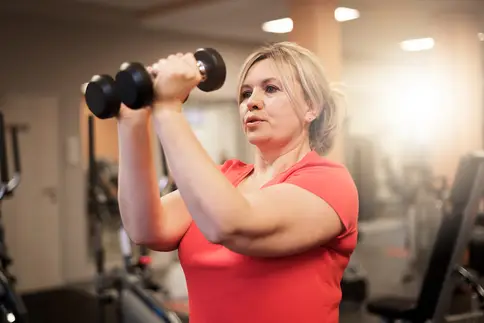
important for all people with liver disease to incorporate weight-bearing exercises into
their daily exercise routines. First, people with liver disease need good strong bones
because they are prone to osteoporosis. Weight training is the best way to fight against
this, as stronger muscles equal stronger bones. Second, in advanced stages of liver
disease, the body is forced to recruit muscle as a source of energy, and people are at risk
of developing severe muscle wasting and greatly diminished strength. However, if a
person has a reserve of muscle built up on her body, it will take a much longer time for
this complication of liver disease to develop. Third, people who have too much fat on
their bodies are at risk of worsening their underlying liver condition by developing
nonalcoholic fatty liver disease (NAFLD). Weight training reduces the amount of fat on
the body and increases muscle mass. Therefore, the chance of developing NAFLD will be
reduced. Finally, since muscle weighs more than fat, weight training is the perfect means
of gaining lean healthy weight for those people who are underweight.
One exception to weight training should be mentioned. People with cirrhosis
complicated by esophageal varices should avoid weight training. This is because wall
tension in the esophagus may drastically increase with weight training which puts this
group at increased risk for esophageal variceal rupture and hemorrhage.
Once again, there are lots of self-help books and videotapes that describe how to
create a personalized weight-bearing exercise routine. It's a good idea to hire a personal
fitness trainer, who can design a personalized routine specific to an individual's needs. It
is important that the trainer be aware of the client's liver disorder, and that consequently,
the client will not always be able to exercise to her fullest capacity. A person with liver
disease should never push herself excessively, nor should she allow herself to be pushed
by a trainer. If she feels too tired or if a body part feels strained, she should stop
exercising until she feels better. Fitness training has become a field that requires
certification, so make sure that the trainer is certified.
It is important to remember to work out every part of the body evenly. Did you know
that there are eleven distinct body parts to work out! In that way, the chances of injury are
decreased. A few stretching exercises should always be performed first to warm up the
muscles before doing weight-bearing exercises. The amount of weight being lifted should
allow for eight to twelve repetitions. Each repetition (rep) is defined as one full and
individual execution of a particular lifting exercise. A set is a distinct grouping of
repetitions, followed by a brief rest interval. Three sets of a given type of exercise should
be performed. Aim to work out each body part at least once a week. Twice a week is ideal.View Thread

Aerobic exercise trains the heart, lungs, and entire cardiovascular system to process and
deliver oxygen more quickly and efficiently to every part of the body. It's the kind of
exercise that gets the heart pumping. As one becomes more aerobically fit, the heart
won't have to work as hard to pump blood to the rest of the body, including the liver. The
pulse will begin to slow down, making it easier for the liver to send back to the rest of the
body the blood it has just filtered. The benefits of being an aerobically fit person include
an overall improved energy level, which translates into decreased fatigue. Fortunately, a
person does not have to purchase high-fashion workout clothes or go to a fancy gym to
get aerobic exercise. Walking briskly, bicycling (either stationary or regular), swimming,
or using a treadmill all provide solid aerobic benefits. Many people start off with
something easy, such as walking around the block. A helpful hint is to start by walking up
and down the street close to home. In that way, if a bout of fatigue suddenly occurs, it
won't take long to get home.View Thread

they each play a different role in fighting liver disease. It is fortunate that there are an
abundance of books, videotapes, and television programs that teach, step by step, both
types of exercises. It is important to use these self-help materials prior to starting any
exercise regimen. Other helpful ideas include scheduling a few appointments with a
personal trainer to design a fitness routine that personally meets the needs of a person
with liver disease. Many fitness trainers will even work in their clients' or the trainer's
homes. And recently, one-on-one fitness training facilities have become widespread.
They offer both privacy and personalized attention. This is important, as many people are
too self-conscious or too shy to exercise in a crowded gym, and/or lose self-motivation
after the first few sessions at a gym. A welcome development has been the appearance
very recently, of gyms geared specifically to individuals who are not in good shape. In
these facilities, embarrassment is mitigated and the convergence of similarly situated
clientele creates an environment akin to a combination support group/health club. Finally,
the likelihood of success is increased if a person adopts an exercise program that she
already enjoys and that can easily be adhered to with consistency at least three times a
week.
Timing is also important. It is fine to exercise at any time of the day that is personally
convenient. However, by the end of the day, most people are usually too mentally and
physically tired to do anything, least of all, run on a treadmill! That is why most people
with liver disease find that they need to do their exercises first thing in the morning.
While some people may find it difficult to get up in the morning in the first place, once
they get started with an exercise regimen, it will become easier and easier. And people
usually find that exercising in the morning helps give them an extra boost of energy to
make it through the day. Finally, don't overdo it. It's more important to maintain a regular
routine than to set any records.
Aerobic Exercises
Aerobic exercise trains the heart, lungs, and entire cardiovascular system to process and
deliver oxygen more quickly and efficiently to every part of the body. It's the kind of
exercise that gets the heart pumping. As one becomes more aerobically fit, the heart
won't have to work as hard to pump blood to the rest of the body, including the liver. The
pulse will begin to slow down, making it easier for the liver to send back to the rest of the
body the blood it has just filtered. The benefits of being an aerobically fit person include
an overall improved energy level, which translates into decreased fatigue. Fortunately, a
person does not have to purchase high-fashion workout clothes or go to a fancy gym to
get aerobic exercise. Walking briskly, bicycling (either stationary or regular), swimming,
or using a treadmill all provide solid aerobic benefits. Many people start off with
something easy, such as walking around the block. A helpful hint is to start by walking up
and down the street close to home. In that way, if a bout of fatigue suddenly occurs, it won't take long to get home.View Thread

Exercise is essential in order to decrease the incidence of potentially detrimental bone
disorders. Osteoporosis is a bone disorder frequently associated with liver disease. It
results in decreased bone density, thereby leading to fragile, easily fractured bones. While
osteoporosis is a disease that most frequently affects postmenopausal women, it can also
affect premenopausal women and men with liver disease. Postmenopausal women are
particularly susceptible to osteoporosis because, as estrogen production stops, bone loss
accelerates. Furthermore, women naturally have a lower percentage of muscle and bone
mass than men. This further increases their risk of developing osteoporosis. Other risks
for osteoporosis in people with liver disease include excessive alcohol use, primary
biliary cirrhosis, advanced cirrhosis from any liver disease typically resulting in muscle
wasting, and the use of prednisone. Fortunately, people can reduce the likelihood of
developing osteoporosis by making exercise and a healthy diet part of their lifestyle.
Just as muscles grow in response to muscle contractions, bone strength and density
increase when the muscles attached are contracting. Studies have shown that muscle and
bone growth promoted by frequent weight-bearing exercise is vital to the prevention of
osteoporosis. Supplementing the diet with at least 1,000 to 1,500 milligrams per day of
calcium in combination with vitamin D is also important. If a person already has
osteoporosis, it needn't keep her from exercising, but she will have to use more caution
so as to keep from breaking any bones. High impact aerobic exercises, which involve
jumping and twisting, can increase the risk of injury and should be avoided. Low impact
exercises, such as swimming and walking, are the safest choices for aerobic exercise.
Weight-bearing exercises with light weights can generally be safely performed. Close
attention should always be paid to proper form. Running on a hard surface, such as
concrete pavement, should be avoided. Soft surfaces, such as specially designed running
tracks, a treadmill or a sandy beach, are preferable.View Thread

well-being and an improved self-image. It is a known fact that if a person feels well
mentally, her immune system will be stronger and give her that extra edge needed in the
fight against disease.
Second, as previously discussed, exercising gives a person a boost of energy. Fatigue
is probably the most common as well as one of the most bothersome symptoms that
plagues people with liver disease. Many people with liver disease frequently feel like
they don't have enough energy to make it across the room, let alone around the block.
However, the best way to fight this seemingly relentless exhaustion is to exercise. Yes,
the notion of exercising when you are fatigued may seem counterintuitive- like a vicious
cycle, but most people find that it actually works. In part, fatigue may have to do with the
fact that both the heart and the liver are working overtime to keep a good supply of
filtered blood circulating throughout the body. Adding a regular exercise routine enables
both organs to work more efficiently. Over time, this will boost energy levels. While most
people find it tough going at first, they eventually realize that the benefits make it well
worth it.
Third, exercise improves cardiovascular function. As the body gets stronger and more
aerobically fit, the cardiovascular system will be able to work more efficiently. Less
effort will be required of the heart to pump blood to the liver and other body organs. Less
effort on the heart equals stronger cardiovascular function and an increased overall
energy level for a person with liver disease. It is extremely important to attempt to do
some exercise while on interferon treatment, as this will decrease the fatigue, irritability,
and depression often associated with this medication.
Fourth, exercise results in a reduction of total body fat. While nearly everyone knows
that being overweight places a great deal of stress on the heart, most people don't realize
that it also makes it harder for the liver to do its job. When total body fat is reduced, fat
content in the liver is simultaneously reduced. This often results in a significant reduction
of elevated liver enzymes, no matter what the underlying liver disorder is. Eating right
and getting plenty of exercise is undoubtedly the slowest way to lose weight known to
humanity, but it's also the safest and surest. This is especially true for people with liver
disease. Even intermittent exercise has been shown to be beneficial in obese women.
Combining a healthy diet with regular exercise is also the best way to keep from
regaining the weight.View Thread
Women's Health Newsletter
Find out what women really need.
Other Hepatitis Information
More Related Communities
The opinions expressed in WebMD User-generated content areas like communities, reviews, ratings, or blogs are solely those of the User, who may or may not have medical or scientific training. These opinions do not represent the opinions of WebMD. User-generated content areas are not reviewed by a WebMD physician or any member of the WebMD editorial staff for accuracy, balance, objectivity, or any other reason except for compliance with our Terms and Conditions. Some of these opinions may contain information about treatments or uses of drug products that have not been approved by the U.S. Food and Drug Administration. WebMD does not endorse any specific product, service, or treatment.
Do not consider WebMD User-generated content as medical advice. Never delay or disregard seeking professional medical advice from your doctor or other qualified healthcare provider because of something you have read on WebMD. You should always speak with your doctor before you start, stop, or change any prescribed part of your care plan or treatment. WebMD understands that reading individual, real-life experiences can be a helpful resource, but it is never a substitute for professional medical advice, diagnosis, or treatment from a qualified health care provider. If you think you may have a medical emergency, call your doctor or dial 911 immediately.
Health Solutions From Our Sponsors
©2005-2012 WebMD, LLC. All rights reserved.
WebMD does not provide medical advice, diagnosis or treatment. See additional information.